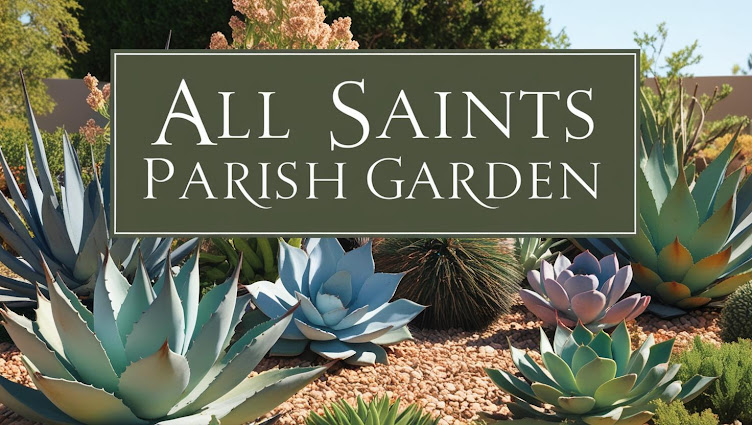
Here’s a glimpse of the All Saints Parish Garden, photos I just took today on my iPhone. Be sure to click them to make them larger and see all the detail of the countless intricate patterns and colors that are interwoven through this space...


At every baptism, there is a prayer in the Baptismal Rite that the priest prays over the person right after they are baptized into new life in Christ:
"Heavenly Father, we thank you that by water and the Holy Spirit you have bestowed upon these your servants the forgiveness of sin, and have raised them to the new life of grace. Sustain them, O Lord, in your Holy Spirit. Give them an inquiring and discerning heart, the courage to will and to persevere, a spirit to know and to love you, and the gift of joy and wonder in all your works. Amen."
I have always loved that prayer, especially that last line. Over the years, my expression of daily prayer has taken many different forms. Sometimes it has involved praying the daily office and other times I have used different poetry and prayers like e.e. cummings poem ‘i thank You God for most this amazing’ or Saint Patrick’s Breastplate as morning prayers. These days my prayer manifests more like “joy and wonder” in God’s works. I’m not in a place of my journey where I feel I need to plead, tell, or ask God what to do. God knows our deepest needs, longings, and willingness. For me, these days, prayer manifests as "joy and wonder in all [God’s] works.” When I pray for people, too, it is less a prayer to direct God what to do and more a prayer of holding that person in the Light of Christ, as the Quakers say.
The All Saints Parish Garden is a place that activates for me deep joy and wonder in God’s works. There’s always something blooming, something changing, plants going dormant as other plants emerge— bulbs like boophone and amarylis. Leucadendron glowing, cycads pushing new leaves, and cosmos dancing across the garden like stars in the night sky. Here are a couple photos I took just this week…


Even though I just planted white cupcake cosmos, this year we had this brilliant bi-color volunteer. On the right is a bromeliad bloom stalk holding onto its last yellow flower on the very top of the bract. The red part is what’s called a bract, and is not actually the flower. The bract is a modified leaf structure that supports the flowers and it is usually very bright and will stay colorful long after the flowers have all faded. In this case, the bract is red and the flowers yellow. The brown pointy tubes are actually the curled and dried flowers with one remaining in tact on the very top. Plants are so fascinating!
I believe that appreciating God’s creation is pleasing to God. In fact, there is an ancient compilation of the writing of spiritual mystics of the early Christian church from the 4th through 15th centuries that is entitled the Philokalia, which in Greek means “love of the beautiful” (from philia meaning “love” and kallos meaning “beauty”). How fitting that this is the title. I think love of beauty is central to my religion and prayer.
And I don’t mean just aesthetic beauty according to some refined standard. There is beauty in our human frailty, in vulnerability, and even the Japanese art of Kintsugi reveals the beauty in brokenness. We are surrounded by beauty everywhere, just as we are encompassed by God in all times and places. I believe the more we attune our hearts to finding beauty, in all places and circumstances, the closer we come to an awareness of God’s deepest presence.
Fr. Justin+, 2/12/2026


